


How NCATS Is Accelerating Drug Discovery: A Behind-the-Scenes Look With NIH Leadership
April 16, 2026
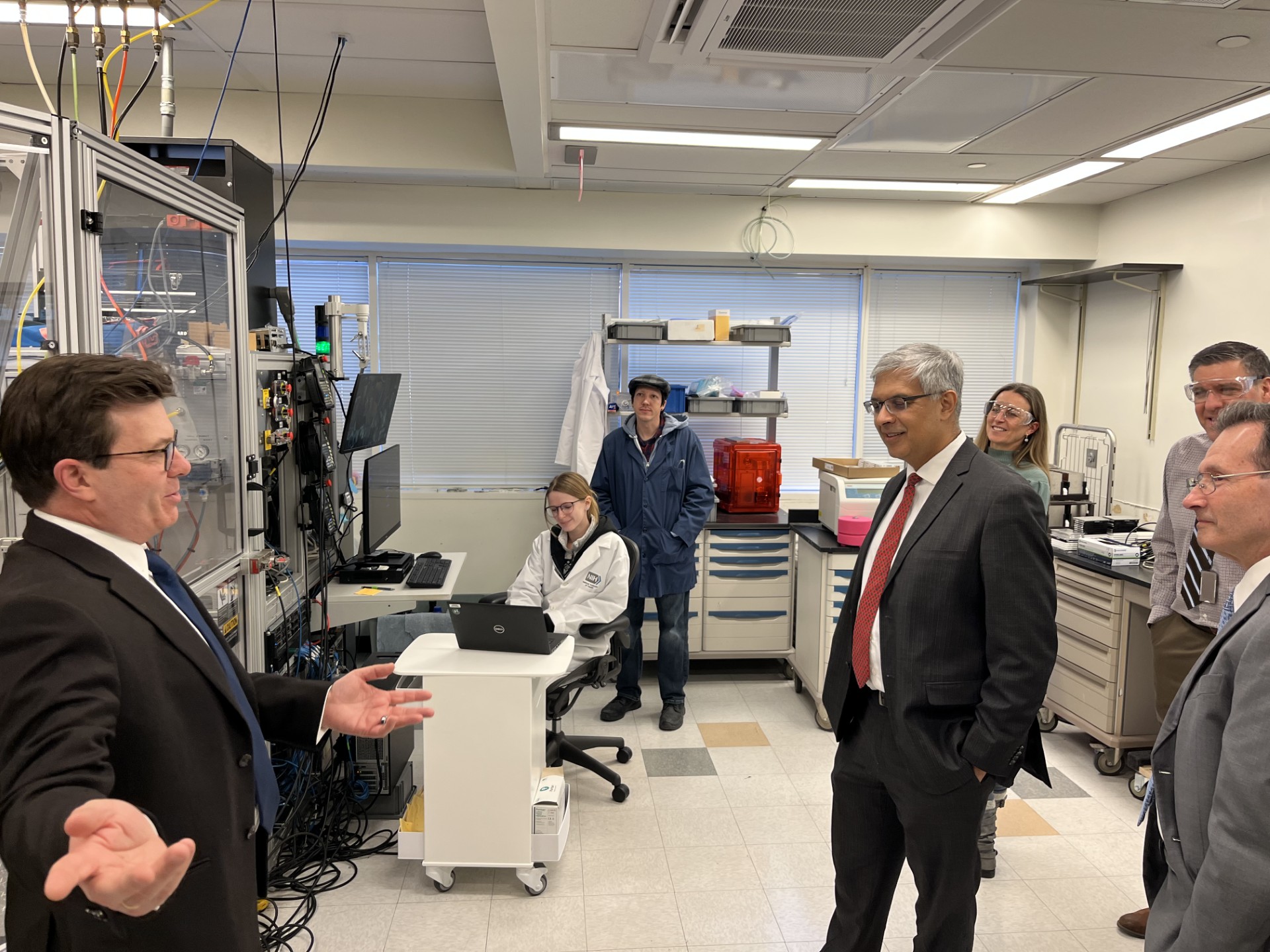
Dr. Bhattacharya being greeted at the NCATS lab by Dr. Matt Hall and other NCATS scientists. (NCATS)
Inside a laboratory at NCATS, human heart cells beat rhythmically in a dish — offering a glimpse into how the future of drug development may unfold. During a recent visit, NIH Director Jayanta “Jay” Bhattacharya, M.D., Ph.D., joined senior NIH leaders Principal Deputy Director Matthew Memoli, M.D., M.S., and Deputy Director for Program Coordination, Planning, and Strategic Initiatives Nicole Kleinstreuer, Ph.D., to learn how NCATS is using cutting-edge technologies to move from basic science to clinical care. “This was a great opportunity for Dr. Bhattacharya, Dr. Memoli and Dr. Kleinstreuer to see firsthand the capabilities of NCATS and the unique nature of the work we do, and how it helps to be a bridge between the basic and clinical research in an innovative way,” said Annica Wayman, Ph.D., NCATS deputy director.
At NCATS’ 3-D Bioprinting Laboratory, leaders saw how scientists develop organoids — complex, human cell–based models that can mimic how diseases behave in the body. In one demonstration, heart cells contracted in real time, allowing researchers to observe how cardiac tissue responds to different compounds. These models are part of a broader push toward novel alternative methods, or NAMs, which reduce reliance on animal testing while improving scientific accuracy. “If you’re going to find a drug that fixes a problem, you don’t just need a tissue model; you also have to be able to measure the drug actually working,” said Matthew Hall, Ph.D., scientific director of NCATS’ Division of Preclinical Innovation.
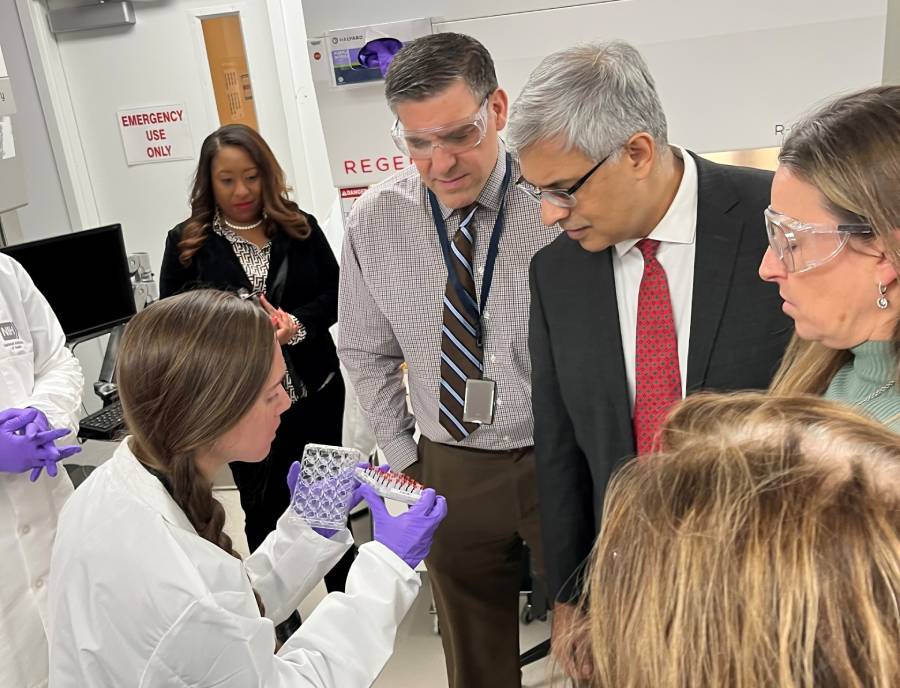
Drs. Jay Bhattacharya, Matthew Memoli and Nicole Kleinstreuer view a well plate held by an NCATS scientist. (NCATS)
The visit also highlighted how automation is transforming the pace of discovery. In NCATS’ high-throughput screening facility, robotic systems grow and maintain cell cultures and test large numbers of compounds — far faster and more consistently than traditional methods. “A lot of us remember the challenges we had decades ago with culturing cells manually,” said Wayman. “It’s very cool to see how robust the system is in culturing so many cells in such a short period of time.” NCATS biologists use these robots to screen hundreds of thousands of molecules, either one at a time or in different combinations, to find starting points for new drug discovery. “There are very few things like that in the public sector anywhere, where you can just walk in and watch drug discovery in action,” Hall said.
At the compound management laboratory, leaders saw a repository of nearly 1 million compounds that supports researchers across NIH and beyond. “We have these huge freezers with little robotic fetchers inside — they’re like massive vending machines,” Hall explained. These machines dispense the samples acoustically — using sound waves to transfer liquids without touching them, eliminating the need for pipettes. The droplet moved by the sound wave is a precise size, so compounds and drugs can be added to experimental plates in specific amounts and combinations. Acoustic dispensing also ensures there is no cross-contamination. This means that each experiment is conducted with the highest level of integrity and specificity. “Dr. Bhattacharya got a real kick out of seeing how we work hard to bring automation to the translational science we’re doing,” Hall said.
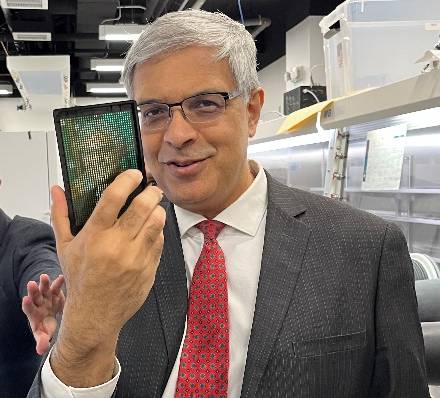
NCATS scientists designed a pixelated image on a 1536-well microplate as a special keepsake for Dr. Jay Bhattacharya. (NCATS)
The tour concluded at the new ASPIRE/APP Biology Lab, where automated platforms standardize how complex tissue models are handled, further improving reproducibility in research. As a fan of maker activities, Bhattacharya also was excited to see NCATS’ maker space with 3 D printers and a 3-D scanner. Hall pointed out that each of the instruments on the tour is available to all NCATS researchers, supporting a collaborative team science environment. “Everything we showed them is a shared environment for all the scientists working here, without any charges or payment required. It’s an open, collaborative environment,” he said.
But while the technology impressed, it was the people behind it that stood out most. NIH leaders spent time speaking with trainees and researchers about their work and the future in translational science.
“People love the robots, but it’s the humans that make it happen,” Hall said. “They came and looked at the robots, but they spent a lot more time with our scientists. It was exciting to see them excited, to see them meet our trainees and learn about their research and career goals, and it showed how committed they are to the intramural program.”
For Wayman and Hall, the visit underscored the importance of making translational science visible — not just in concept, but in practice. As new technologies continue to reshape how treatments are discovered and developed, the ability to connect innovation with real-world impact remains central to the center’s mission.