


Tissue Chips in Space 2.0 Will Reveal Age-Related Disease Mechanisms and Possible Therapies
Feb. 17, 2026
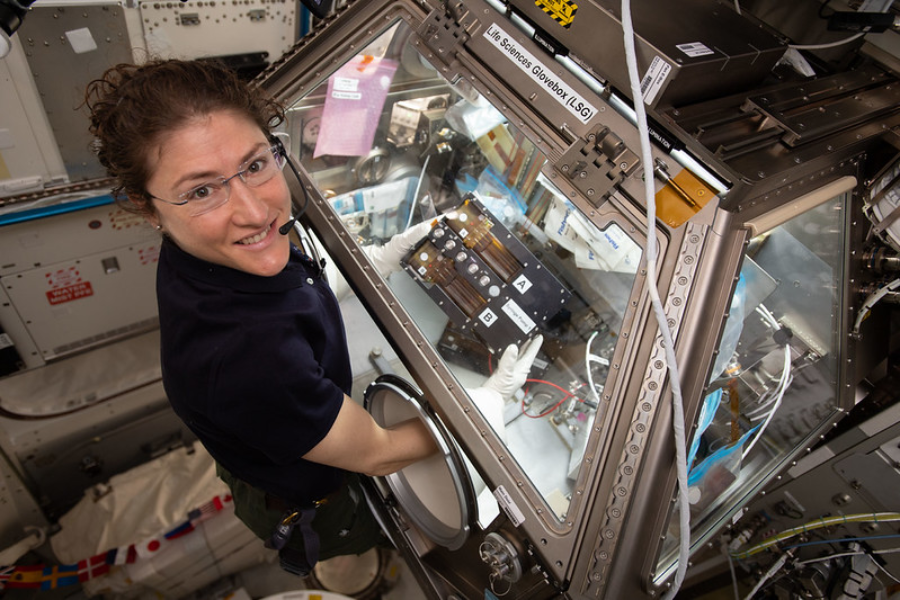
NASA astronaut Christina Koch works on a tissue chip experiment onboard the International Space Station. (Image courtesy of NASA)
During spaceflight, the human body is exposed to unique conditions, one of which is microgravity (diminished or close to zero gravity compared with Earth). Spaceflight ages the human body at an accelerated pace, and it mirrors aging-related functional decline and age-related diseases, such as cardiac dysfunction, immunosenescence (decline in the immune system), osteoporosis (bone density loss) and fibrosis (excessive buildup of a substance called the matrix around cells). These conditions take an extended period to study on Earth. Using the faster speed of aging seen in space, researchers can model disease progression and identify new therapies more quickly than on Earth. The International Space Station National Laboratory (ISS-NL) gives the biomedical community a unique setting — spaceflight — to study aging and age-related diseases.
Microphysiological systems (MPS) are bioengineered microfluidic devices (micro-sized fluid channels) seeded with human cells and tissues, which allow researchers to mimic organ systems and functions. MPS have many advantages compared with traditional cell cultures and animal models. The systems provide a more accurate model of the human body for identifying how diseases work, testing new therapies and checking for drug toxicity. MPS are quickly becoming vital tools for drug discovery, regulatory approval, safety and efficacy tests, and precision medicine.
Tissue Chips in Space 2.0 is a follow-up to the Tissue Chips in Space initiative that began in 2016. That initiative sought to create tissue- and organ-on-chip models that could be sent to the ISS-NL. Tissue Chips in Space 2.0 is focused on refining tissue chip technology by creating and using multiorgan MPS to better model the whole body. In 2025, NIH selected six grants through a cooperative agreement, which is a funding method that has two phases. In the first phase, researchers will design MPS that mimic complex organ systems. The MPS will be validated and tested on Earth and in space to ensure the chips are functional and sustainable for experiments at the ISS-NL in demonstrating an accurate representation of normal and diseased human states. After NIH review, the second phase will allow selected researchers who developed successful chips to send their MPS into low Earth orbit at the ISS-NL to show the functional utility of the models. These models will help us understand the effects of microgravity on human physiology and age-associated conditions and to identify novel targets for drug screening.
Using the faster rate of aging seen in space, these studies at the ISS-NL will identify clinically relevant markers of disease, pinpoint mechanisms that promote disease progression and examine possible therapies for a number of conditions. These efforts could provide key data and create a preclinical framework to inform clinical trials for aging-related decline and diseases. This research can also help address the challenges related to the effects of low Earth orbit and deep space exploration on astronauts’ health.
“The Tissue Chips in Space program is exceptionally exciting because it enables unprecedented experiments with microphysiological systems under microgravity conditions that only space can provide. These studies will help uncover disease mechanisms and may open new avenues for therapeutic development. In addition, the program will drive advances in microphysiological technologies, improving their ease of use and expanding the accessibility of tissue chip platforms for research on Earth,” said Dmitriy Krepkiy, Ph.D., program officer of NCATS’ Office of Special Initiatives, which administers the Tissue Chip for Drug Screening Program.
Learn more about the 2025 awarded projects:
- Brain–Muscle Microphysiological System Enabled Extracellular Vesicle Network for Understanding Aging in Space
Research: Crosstalk between the brain and muscles plays a key role in age-related diseases, including Alzheimer’s disease and Parkinson’s disease. Extracellular vesicles (EVs) are small particle vehicles for molecules that affect tissues throughout the body. Understanding how EVs are used in the two-way communication between the brain and muscles could provide researchers with therapeutic targets for prevention of and recovery from age-related diseases.
Principal Investigators: Mei He, Ph.D., University of Florida, and Luke Lee, Ph.D., Brigham and Women's Hospital
- Assessing Effects of Microgravity on Cardiovascular Aging With AI and 3D Organoids
Research: Microgravity can cause negative health effects on the heart, and it is important to understand how the space environment alters heart function, metabolism and response to stimuli. Comparing the results obtained in space to tests completed in a lab on Earth will help researchers learn how the unique environment of space affects the heart. This study will help identify possible therapeutic candidates for heart disease and inflammatory conditions and improve astronaut health during long-term space exposure.
Principal Investigators: Joseph Wu, M.D., Ph.D., Stanford University, and Afshin Beheshti, Ph.D., University of Pittsburgh
- An Organ-on-Chip Approach to Evaluation of Reproductive Health, Aging and Disease in Women
Research: Uterine aging is linked to an increased risk of cancer and reproductive issues, such as infertility and poor pregnancy outcomes. Using different cell types from the female reproductive system combined with hormone exposure, researchers will find mechanisms underlying uterine aging. Combined with artificial intelligence and machine learning, potential compounds to treat uterine aging will be selected for use in future studies.
Principal Investigator: Carrie German, Ph.D., CFD Research Corporation
- Using Microgravity to Model Inflammaging in Complex Organ Chip Models of Heart, Gut, and Brain
Research: A buildup of damaged proteins and senescent cells (cells that no longer divide but are still metabolically active) can disrupt the ability of the heart, gut and brain to function properly. Chronic inflammation related to aging — known as inflammaging — can be triggered by immune cells, such as monocytes and macrophages, when they no longer function properly. Researchers plan to uncover mechanisms that cause faster immune cell aging and tissue dysfunction. Compounds that target senescent cells will be tested to discover which ones could help reverse cellular aging and improve human health.
Principal Investigators: Arun Sharma, Ph.D., and Clive Svendsen, Ph.D., Cedars-Sinai Medical Center
- Exploiting Accelerated Aging Associated With Low Earth Orbit (LEO) Environment to Gain Insights Into Pathogenesis and Treatment of Progressive Neurological Disorders
Research: Age is the most important risk factor for late-onset Alzheimer’s disease (AD). Through communication between the brain and the heart, AD and other brain diseases can affect the cardiovascular system. Researchers will study the crosstalk between the heart and the brain in a setting where brain function has declined. They will test compounds that selectively target senescent cells to determine whether they are an effective therapy for preventing brain and heart health problems.
Principal Investigators: Palaniappan Sethu, Ph.D., Krishna Bhat, M.D., Ph.D., and Prasanna Krishnamurthy, Ph.D., The University of Alabama at Birmingham
- An Aging Alveolar Lung Model in Microgravity
Research: Lungs contain various cell types — such as epithelial cells, endothelial cells, fibroblasts and immune cells — that play an important role in maintaining respiratory health and function. Researchers will create a lung model to study the interplay between aging-related disease conditions, such as fibrosis, and lung aging. This model is a powerful tool that uses these different cell types in a 3-D setting to mimic both healthy and fibrotic lungs, highlighting its use to find therapies for various lung diseases.
Principal Investigator: Y. Shrike Zhang, Ph.D., Brigham and Women's Hospital