


High-Intensity Walking May Reverse Frailty Among Older Adults
November 25, 2026
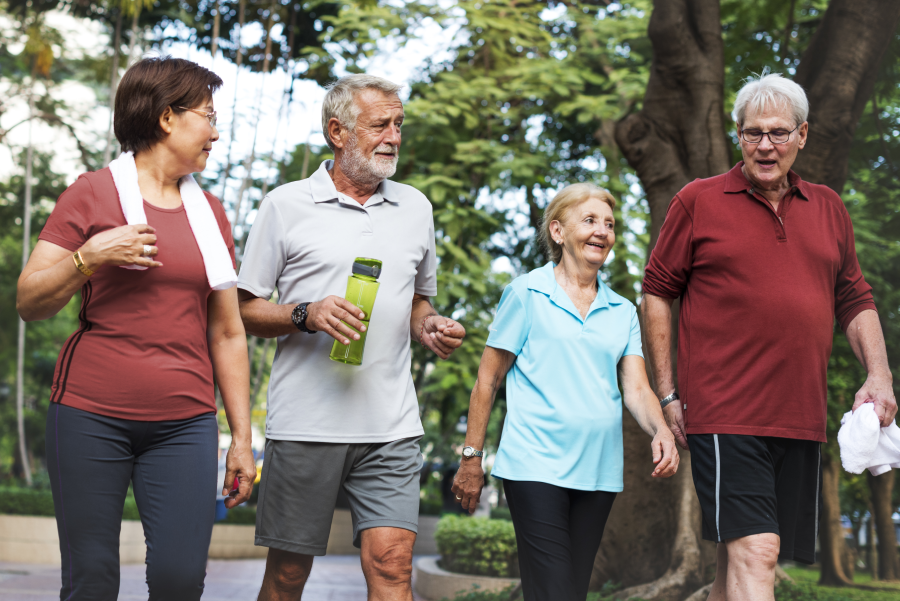
(Shutterstock)
When it comes to promoting healthy aging, prevention strategies, including exercising, eating nutritious food and maintaining a healthy weight, are often encouraged. However, interventions that help reverse poor health, such as existing frailty, are needed, especially with the growing number of older people. New research suggests that a simple strategy — increasing walking intensity — may play an important role in reversing frailty in older people.
A study led by Margaret Danilovich, Ph.D., D.PT., an assistant professor in the Department of Physical Therapy and Human Movement Sciences at Northwestern University, Feinberg School of Medicine, explored a simple idea: Frailty could be reversed if people took part in high-intensity walking (HIW). Published in PLoS One, the team’s findings suggest that increasing the speed of walking helps reverse frailty among adults over the age of 60.
Frailty is a combination of specific features, including muscle weakness, fatigue, weight loss and reduced physical activity. Frailty is common in older people, and it is linked to poor health outcomes, such as loss of independence, hospitalization, being placed in long-term care, and even death. Strategies to prevent frailty as people age focus on lifestyle and behavior, but Danilovich has been interested in the idea that frailty can be reversed. “There is not a lot of research around how you actually reverse frailty, and I think that’s the novel contribution of our study,” Danilovich said. “I saw in the clinic and our health care system this bias that once you’re frail, there’s little to no therapies or treatments recommended to people.”
With support from NCATS’ Clinical and Translational Science Awards (CTSA) Program, Danilovich and her team tested two different walking speeds at 13 retirement communities. They set up a clinical trial where participants were randomized into either the casual-speed walking group or HIW group. Participants in the casual-speed walking group walked at a comfortable pace, whereas the HIW group was asked to walk safely as fast as they could.
During the 16-week supervised walking program, participants completed three 45-minute walking sessions each week. The experimental design was tailored to each participant’s ability and completed at the retirement communities instead of a laboratory, highlighting its practicality for adoption among other communities across the nation.
The researchers collected baseline data, including heart rate and the typical number of steps taken in a day. During the walking program, participants in the HIW group averaged 71% of their maximum heart rate, while the casual-speed walking group reached about 59% of their maximum heart rate. Participants also provided feedback about their perceived exertion during the walking exercises. “Most of our participants were taking beta blockers for their high blood pressure, and that limits what your heart rate does in response to exercise. So, we didn’t want to just rely on heart rate alone since we knew that medication might have that effect,” stated Danilovich. The collection of these data allowed the research team to obtain a thorough idea of the exercise intensity for each participant, supporting NIH’s goal of gold standard science.
The study revealed several key findings. In the HIW group, 70% of the participants improved by at least one frailty category — frail to pre-frail or pre-frail to non-frail — while only 46% of participants in the casual-speed walking group saw this improvement. The HIW group members also had a faster walking speed and better walking ability when compared to their baseline data. These participants could walk farther in a shorter period of time and were able to take more steps in a day. “The degree of improvement is much more significant in the higher intensity, so the intensity of walking may influence how much benefit people get,” emphasized Danilovich.
Overall, these findings inform a growing understanding that frailty is not a linear trajectory — patients with frailty can participate in activities that may reverse key features of frailty. By exploring how walking speed impacts frailty, the study reflects NCATS’ mission to turn research observations into practical interventions that can improve health outcomes. The study also aligns with broader HHS efforts to understand the aging process and develop strategies that support the health and independence of people as they grow older.
In the future, the research team plans to study whether these findings can be replicated in other populations and if using technology, like smartphones and smartwatches, could make these interventions accessible to more people.
Michael Kurilla, M.D., Ph.D., director of NCATS’ Division of Clinical Innovation, which administers the CTSA Program, stated, “Identifying straightforward, implementable lifestyle behaviors that positively impact frailty offer low cost, low touch solutions that address a growing problem.”