


October 9, 2026
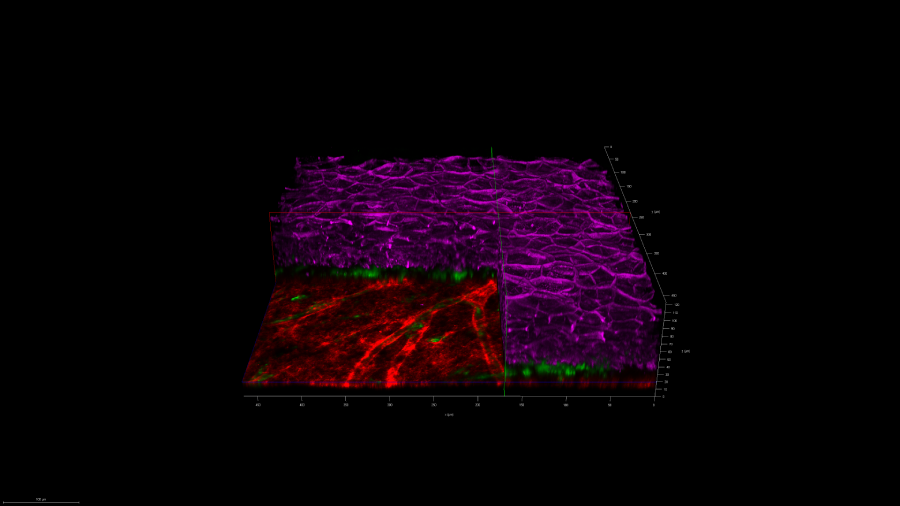
3D rendering of biofabricated normal skin tissue using confocal fluorescence microscopy images. (Source: Min Jae Song and Xue Liu, NCATS)
Much like how bricks need mortar to hold up a wall, your cells rely on extracellular matrix (ECM) to build and support tissues and organs. However, in many disease settings, too much ECM is produced. This excess buildup — called fibrosis — causes tissue scarring that can impair organ function and, in severe cases, lead to organ failure.
Marc Ferrer, Ph.D., director of NIH’s 3-D Tissue Bioprinting Laboratory, emphasized the importance of finding treatments for fibrosis. “Fibrotic diseases are the cause of high morbidity and mortality worldwide. It affects a lot of people — almost 1 in 4 people. There are just a couple of approved treatments that target the underlying causes of tissue scarring and do not work for all fibrotic disease.”
Led by Ferrer at NCATS and Darlene Dixon, Ph.D., at the National Institute of Environmental Health Sciences (NIEHS), the 3D MultiOrgan Models of Fibrosis (3D-MOFIB) technology development center (TDC), funded by the Complement-ARIE program, is developing new approach methodologies (NAMs) that use human-based models to better understand fibrotic diseases and accelerate the discovery of potential treatments. Researchers will initially focus on scleroderma, which causes excessive scarring of the skin, and Hermansky Pudlak syndrome pulmonary fibrosis, a rare disease that affects the lungs. By combining human 3-D tissue models, high-throughput drug screening and AI-driven computational models, 3D-MOFIB aims to improve researchers' ability to identify promising therapies that are both effective and safe.
A collaborative team of researchers from several institutes at NIH, including NCATS, NIEHS, the National Institute on Alcohol Abuse and Alcoholism and the National Human Genome Research Institute and academics at University of Michigan are working together to support the goals of the 3D MOFIB TDC. The team will isolate fibroblasts — the cells primarily responsible for producing ECM — from healthy patients and patients with these diseases and grow them to reconstitute human skin and lung tissue models in multi-well plates. This scalable approach allows researchers to screen hundreds of potential drugs and compounds while measuring multiple features of fibrosis. Promising drug candidates will then be evaluated for potential toxicity using liver, brain and heart NAMs being developed by members of the 3D-MOFIB TDC. The collection of fibroblasts from multiple patients with the same disease will allow the study of differences in how individuals respond to treatment. The resulting biological data will be used to develop AI-driven computational models that can predict which chemical structures are most likely to produce anti-fibrotic effects. These data and models will be shared with the broader research community to support development of therapies for other fibrotic diseases.
The 3D-MOFIB TDC team also plans to use advanced techniques — including transcriptomics, proteomics and metabolomics technologies — to identify molecular signaling that drives fibrosis. The researchers will pinpoint gene and protein patterns that are unique to fibrotic diseases of interest compared with healthy tissues. By identifying molecular patterns shared across different fibrotic diseases, researchers hope to discover therapies with the potential to treat multiple conditions. This approach supports NCATS’ mission to increase the pace of development and availability of treatments and enables more individuals to benefit from translational science.
Beyond advancing fibrosis research, the 3D-MOFIB TDC will help train the next generation of translational scientists. The center plans to offer seminars, workshops and educational resources on assay development, drug screening and related technologies — making these skills and tools more broadly available to the biomedical research community.
Christine Happel, Ph.D., program officer for NCATS’ Office of Special Initiatives and Co Coordinator for the Complement-ARIE program, stated, “The 3D-MOFIB TDC will address two Complement-ARIE high-priority scientific areas of need, chronicity and cross-disease pathogenesis. Understanding what leads to fibrosis will be broadly applicable across many fibrotic diseases and clearly demonstrates how the development and application of NAMs can transform how we study health and disease.”
Learn more about the Complement-ARIE program and NCATS’ role.